
Wed, 8 Apr 2026
Carl Orff and the medieval texts: what is the choir actually singing?
What does O Fortuna mean? What does the choir sing in Carmina Burana? We translate the key passages of Carl Orff’s masterpiece and explain why these 800-year-old texts still resonate.
By Music Hall editorial team · Editorial team
Share
Share this article
Related show
Carmina Burana
This article is about Carmina Burana. Visit the show page or explore the dates below.
You recognise it immediately. Those pounding opening notes, the choir washing over you like a wave. O Fortuna is one of the most recognisable compositions in the world, used in films, trailers and sports broadcasts. But what is the choir actually singing? And why does it sound so overwhelming?
The texts of Carmina Burana are older than the work itself. Much older.
A manuscript from a Bavarian monastery
The songs are known as Carmina Burana, “Songs of Beuern”, and were first published in 1847. The manuscript itself, the Codex Buranus, was found at Benediktbeuern monastery in Bavaria and dates from around 1220 to 1250.
Most of the poems are written in Latin, but around forty of the love songs also include stanzas in Middle High German, while a few contain Old French and Occitan texts.
Who wrote them? Their knowledge of classical literature, ancient mythology and Latin suggests the authors were not penniless wanderers but probably established clergy, clerics, lawyers, doctors and Latin teachers recalling the pleasures of their student days. Churchmen who knew their way around a tavern, in other words.
What did Carl Orff choose, and what did he leave out?
Of the manuscript’s more than 200 texts, Orff selected 24, dealing with the fickleness of fate, spring and love, drinking and satire. He kept the Latin and Middle High German texts intact and composed entirely new music for them. This was no attempt at historical reconstruction, but a contemporary composition.
The work covers three broad themes: spring and its love songs, the tavern and its drinking and gambling songs, and the Court of Love, about sensual love. Its opening and closing songs address Fortuna, goddess of fate.
That structure is deliberate. Carmina Burana tells the story of the Wheel of Fortune: beginning at the bottom, where fate is lamented; moving through blossoming spring and love to the summit; then turning inevitably onwards until everything collapses again. O Fortuna both opens and closes the work. That is no accident.
O Fortuna: what does it really say?
The best-known piece. O Fortuna is a lament about fate, the unavoidable force that governs gods and mortals alike in Roman mythology.
The text addresses Fortuna as a goddess:
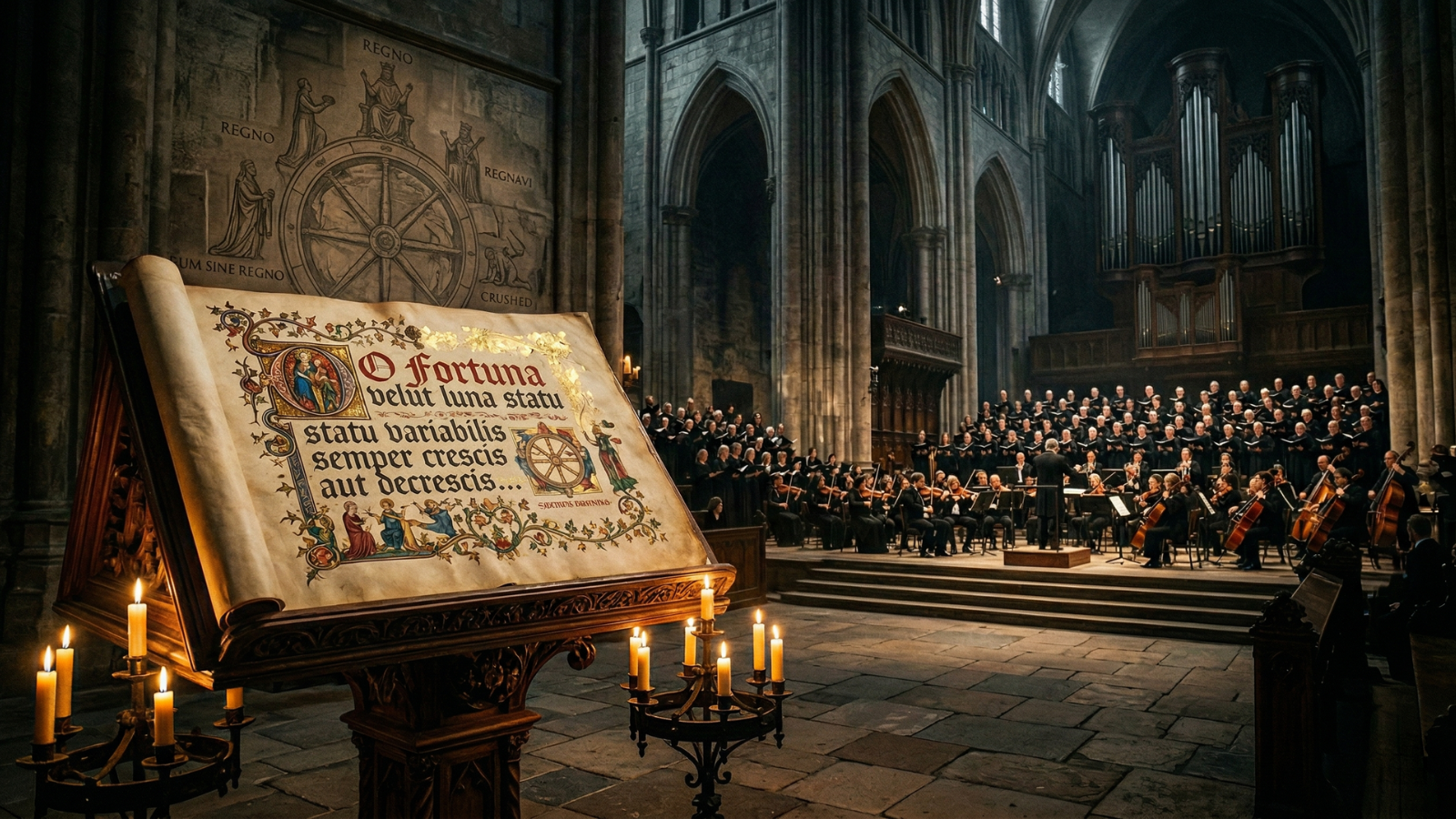
O Fortuna, velut luna statu variabilis — O Fortune, like the moon, you are changeable
The original manuscript includes an image of Fortuna turning the Wheel of Fortune. To the left, a rising figure is labelled Regnabo (“I shall reign”); at the top, a seated king bears Regno (“I reign”); to the right, a falling figure bears Regnavi (“I reigned”); and at the bottom, a fallen figure bears Sum sine regno (“I am without a kingdom”).
The choir calls on listeners to mourn with it: since fate strikes down the strong, weep loudly with me. No comfort. No solution. Only the recognition that fate cannot be controlled, and never could.
The tavern and love: the lesser-known part
Many visitors know O Fortuna but not what comes next. That is where things get interesting.
After its dramatic opening, the work becomes surprisingly human. The three middle sections are called Primo vere (“In early spring”), In taberna (“In the tavern”) and Cour d’amours (“The Court of Love”).
In taberna is outright comic. A famous baritone solo expresses a wish to die in the tavern, with a nod to the medieval Dies Irae, the hymn about the Last Judgement. The climax of In taberna is a drinking song in which the Latin verb bibet (“he drinks”) is repeated 28 times over 16 bars: men, women, rich people, poor people, monks and prostitutes, everyone drinks. The choir stamps out the rhythm on stage while the audience can barely make out what is being sung. It does not need to.
Cour d’amours is the opposite: tender, seductive, sometimes almost whispered. A soprano sings of a girl in a red tunic — Stetit puella — as the orchestra falls briefly silent. From a thundering mass to a single voice. That contrast is exactly what Orff intended.
Why does it sound so overwhelming?
The texts are medieval, but the music is not. Its style draws heavily on Stravinsky’s Les Noces and Oedipus Rex, as heard in Orff’s use of the choir and highly percussive orchestration. Musicalifeiten
Orff wrote for large choral forces that function as one instrument. His harmonies are primitive in the best sense: direct chords with no detours. No subtlety or psychological nuance, just power and rhythm. A Radio Nederland documentary attributes the work’s popularity to its combination of choirs, large orchestra, interesting instrumental colours, tight rhythm and music that is easy to sing and remember.
The words do the rest. Fate, love, drink, longing: themes as relevant today as they were in the thirteenth century.
What you hear live that you miss at home
On a recording, you hear the music. Live, you feel the physical presence of more than 200 performers on one stage: Flanders Boys Choir, the mixed choir Chorale, three soloists and the La Passione symphony orchestra. When the full ensemble begins O Fortuna, the air in the auditorium feels different.
No speaker can reproduce that.
Carmina Burana can be heard on 12 April at the Capitole in Ghent, 3 May at the Stadsschouwburg in Antwerp and 17 May at Bozar in Brussels.