
Sun, 22 Mar 2026
What makes Carmina Burana so powerful? The conductor explains
You know the music, but do you know the work? Conductor Paul Dinneweth explains why Carmina Burana is so much more than O Fortuna and why you should experience it live.
By Music Hall editorial team · Editorial team
Share
Share this article
Related show
Carmina Burana
This article is about Carmina Burana. Visit the show page or explore the dates below.
You do not even need to know the name to recognise the music. That thunderous chorus, the pounding timpani, voices rising towards a skin-tingling climax: O Fortuna is one of classical music’s most iconic openings. Yet Carmina Burana as a whole is so much more than that single passage heard in hundreds of blockbuster films and sporting events.
Music Hall presents Carl Orff’s masterwork on 12 April at the Capitole in Ghent, 3 May at the Stadsschouwburg in Antwerp and 17 May at Bozar in Brussels. We spoke with conductor Paul Dinneweth about what makes it so special, how to prepare a choir and orchestra for such a monumental score and what audiences can expect.
“Everyone knows those opening bars, but does anyone actually know what Carmina Burana is?”
How would you explain Carmina Burana to someone who has never seen it?
“Carmina Burana literally means ‘Songs of Beuern’. It is based on medieval poems Carl Orff found in a Bavarian monastery library in 1936. Written in Latin, Middle High German and Old French, the texts deal with the whims of fate, the beauty of nature, drinking, falling in love and the fleeting nature of life. Orff set them as a cantata that captures everything colourful and unruly about human experience in one evening.”
“The work opens with O Fortuna, an invocation to the goddess of fate who gives and takes everything. That opening scene is both an ending and a beginning: the score is cyclical. At the end you return to precisely the same music and text. Fate turns, and the wheel stops for no one. That is the philosophical heart of the piece too: we are all at Fortuna’s mercy.”
“The music is both ancient and utterly modern”
What sets Carmina Burana apart from other major choral works?
“Orff rejected the romantic weight his contemporaries still cultivated. His harmonies are raw and elemental, his rhythms repetitive and hypnotic, almost tribal. That approach was radical in 1937. But it also makes the music timeless: it does not seem to belong to any particular era and so transcends fashion.”
“Compared with a Bach cantata or a Brahms Requiem, Carmina Burana has a different structure too. There is no continuous narrative, no dramatic conflict in the traditional sense. Instead there are snapshots, tableaux of human emotion. That also makes it accessible to people who rarely attend classical concerts: you need no musical background to be swept away.”
“Rehearsals build towards a kind of collective ecstasy”
How do you prepare an orchestra and choir for Carmina Burana?
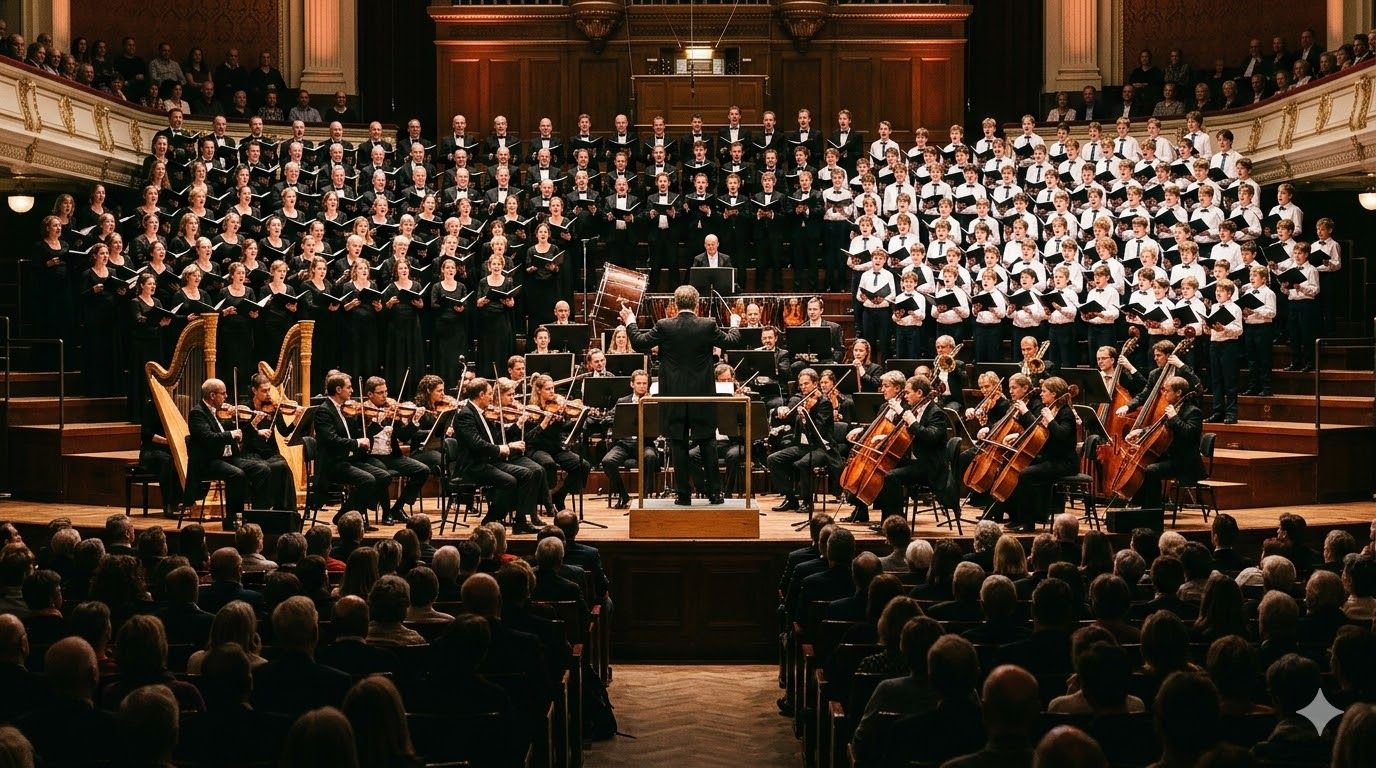
“The technical demands are immense. You need a large symphony orchestra, a soprano, tenor and baritone, a full choir and a children’s choir. All these groups must work together with exceptional precision. A missed entry in O Fortuna — unlikely, but a real risk with such a large ensemble — and the magic can disappear in an instant.”
“In the run-up to the premiere, we rehearse with each group separately. Choir members learn their parts without the orchestra first. Then we add the soloists, then the orchestra. Only in the dress rehearsal, always a rather magical moment, do you hear the complete ensemble for the first time. It is like several rivers joining into one broad stream.”
“Carmina Burana is rhythmically very precise. The pulse must be steady or the accents blur and you lose the drive that makes the piece so exhilarating. At the same time, there must be space for nuance: the quiet, intimate passages are just as powerful as the fortissimo moments.”
“Live, Carmina Burana is a physical experience”
What makes a live performance different from a recording?
“There are fantastic recordings of Carmina Burana. But a recording brings you the music through speakers. Live, the music comes for you.”
“When a choir of more than a hundred singers begins O Fortuna in a venue like Bozar or the Capitole, you can feel the air pressure change. The low strings and timpani resonate in your chest. That is not a metaphor: it is physiology. The acoustics of a large concert hall do more than amplify sound; they wrap you in it. No headphones can ever do that.”
“There is also the theatre of a live performance: the focus on the soprano’s face during her aria, the visible precision with which the conductor cues the timpanist, the shared anticipation as hundreds of singers breathe together before an entry. All of that makes every performance a unique event, for the musicians as well.”
Bolero: the perfect partner
The programme also features Ravel’s Bolero. How do the two works complement each other?
“Bolero and Carmina Burana appear similar on the surface: both rely on repetition, both build towards a crushing climax and both appeal to a wide audience. But they are complementary too.”
“Bolero is one uninterrupted crescendo: a Spanish dance motif repeated for fifteen minutes, growing brighter and bigger until it bursts. It is hypnotic and tightly controlled. Carmina Burana, by contrast, breathes, moves and changes character. After Bolero, the audience enters a completely different emotional world: not Ravel’s taut linear progression but Orff’s explosive variety. The two works strengthen each other.”
“And practically speaking, Bolero opens the evening with something immediately gripping. By the time it ends, the audience is already warmed up. Then Carmina Burana begins, and you know the evening will be unforgettable.”
Experience it live
Carl Orff’s Carmina Burana and Maurice Ravel’s Bolero: an evening that begins with rhythm and ends on a grand scale. Three dates, three iconic venues. Book your tickets soon!